William Anderson Allen was born on April 29, 1825, in Wake County. His family were long-time farmers in the area. Allen grew up on his father’s farm and attended Wake Forest as a young man. He earned a law degree and was elected to the House of Commons shortly after his graduation.
After serving one term in the legislature, Allen moved to Kenansville, where he practiced law with William J. Houston. The two attorneys had a successful practice until the outbreak of war in 1861. During this period, Allen served as County Solicitor and was an elector in the 1860 election, stumping for John C. Breckinridge.
On April 15, 1861, Allen enlisted in the Duplin Rifles, a local infantry company. A week later, he was elected 2nd lieutenant of the company. In May, the Rifles were mustered into State service as Company C, 2nd North Carolina Volunteers and sent to Norfolk, Virginia. The company had enlisted for only six months, and in November, Allen mustered out and returned home.
In early 1862, William Allen and fellow attorney Samuel Stanford decided to raise an infantry company in Duplin County. On February 11, 1862, Allen received a captain’s appointment from the State, and Stanford was appointed a first lieutenant. They named their company the “Duplin Stars.” Within a week, the pair had added 13 men to the company.
Among the first recruits were James Branch (farmer, merchant, and representative serving in the state legislature) and Robinson James (farmer and teacher). Branch was signed on as the company’s 2nd lieutenant and James as the 3rd lieutenant. Their service records state that they were elected to their positions, but only 15 men had joined the company by then, so it is hard to imagine that they held an election. Allen likely “designated” (Allen had no authority to appoint officers) Branch as the company’s 2nd lieutenant and James as the 3rd lieutenant, knowing that when the company mustered into service, the State would commission the two men because they were elected to their positions.
Next, Captain Allen appointed Hiram Houston, a 20-year-old student and Allen’s law partner’s nephew, as the company’s first sergeant. By the end of Allen’s first week as a captain, the company had its officers and its top NCO in place. Ten enlisted men had also joined the company. The group began recruiting in earnest.
Lieutenant Branch went to Wilmington and secured quarters for the recruits in Dry Pond, while Captain Allen and Lieutenant Stanford continued to recruit in Duplin County. As men signed up, they were sent to the quarters in Wilmington where they slept on the bare floor without covers.
By the 1st of April. the Duplin Stars had added 54 more recruits, giving the company a complement of four officers and 65 men. The company moved to a camp (probably Camp Holmes), where they were issued tents. Private Ichabod Quinn wrote to his wife that he was sharing a tent with six other men. He complained that the quartermaster in Wilmington was only issuing the company half rations. The disgruntled soldiers detailed a contingent of 20 men to go into town and confront the quartermaster. If he would not give the men the rations they were due, they would take them by force. The quartermaster gave in, and the company received their full apportionment of food.
Captain Allen was so annoyed by the situation in Wilmington that he threatened to take his company to Raleigh. “I think we will leave this place in a few days for Raleigh,” wrote Private Quinn, “where we can have some accommodation, get our bounty and uniforms, without fighting for it. Our company are all anxious to go.” Allen did not make good on his threat, and the Duplin Stars were enrolled in service at Camp Holmes on April 8, 1862. When the 51st North Carolina was organized a few weeks later, the Stars were assigned as Company C of the new regiment. At the time that the Fifty-First organized, Company C numbered 83 men plus four officers, including seven transfers from Cantwell’s Railroad Guards.
On April 30, the 51st North Carolina elected its field officers. Captain Allen was elected lieutenant colonel. Lieutenant Stanford was promoted to captain, James Branch was promoted to 1st lieutenant, and Robinson James was promoted to 2nd lieutenant. In May, the company elected Sergeant Edward Watson as the new 3rd lieutenant.
X
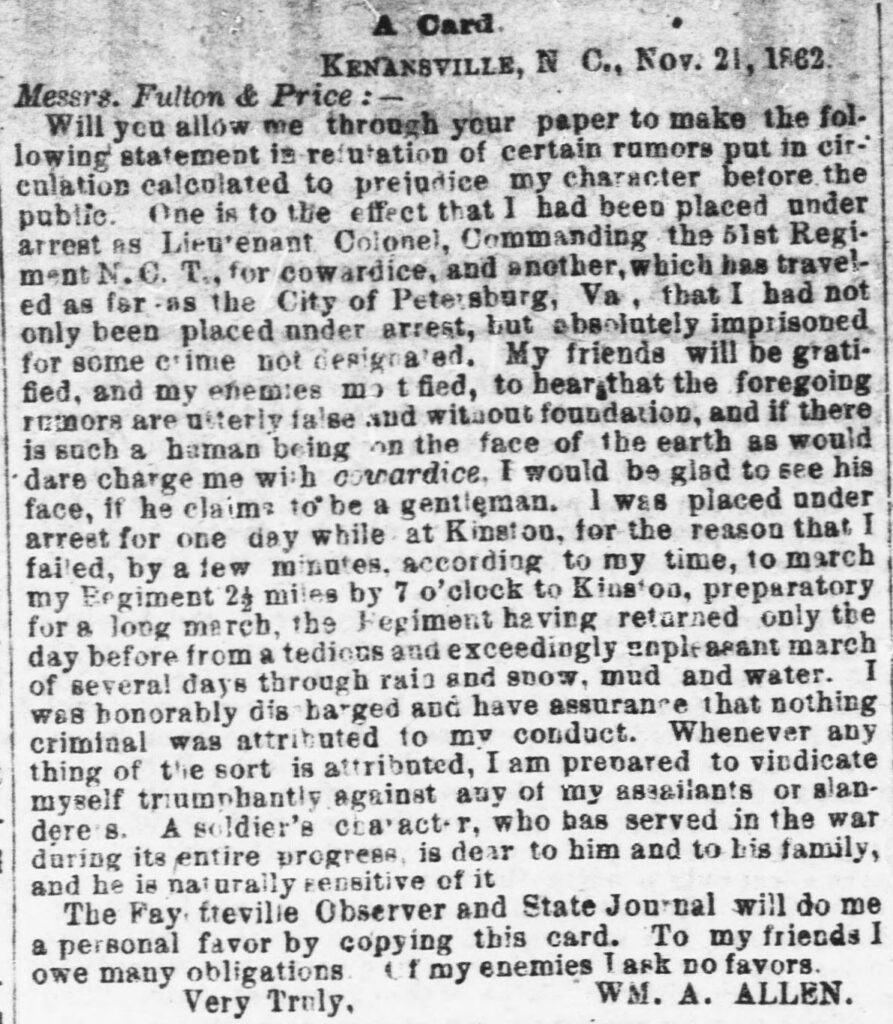
The regiment’s commander, Colonel John Cantwell, resigned in October 1862, and Allen assumed command of the regiment, leading it in its first battle at Goldsboro. His command did not last long. In December, Allen had an intoxicated clash with the regiment’s major (see “Feuding in the Officers’ Ranks” and “Chaos in Command”). Facing court-martial, he resigned on January 19, 1863, and retuned home.
Back in Kenansville, William Allen resumed his law practice and served as major of the 7th Battalion Home Guards and later the 3rd Regiment Home Guards. After the war, Allen remained active as an attorney and was involved in state politics and veteran affairs. He was elected to several terms in the State Senate. William Allen died suddenly of a heart attack in Goldsboro on February 23, 1884.
Allen had two sons, Oliver and William R., who followed him into the law. Both became judges. Oliver served many years as a Superior Court judge. William R. was eventually appointed to the North Carolina Supreme Court.
Copyright © 2021 – 2026 by Kirk Ward. All rights reserved.