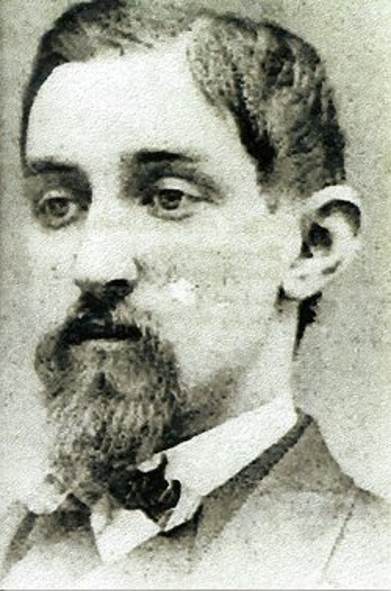
George Fennel Walker was born in New Hanover County on June 27, 1832. He was the fourth child of Edward and Ann Walker, who owned a plantation in the Colvin’s Creek community. George attended school as a child, and when he grew up, he helped his father run the plantation.
In December 1858, George married Mary Henry. The couple moved in with Mary’s mother, a wealthy widow living on a large plantation near George’s parents. In the 1860 census, George’s mother-in-law owned real estate and property worth $37,600. George had no occupation listed.
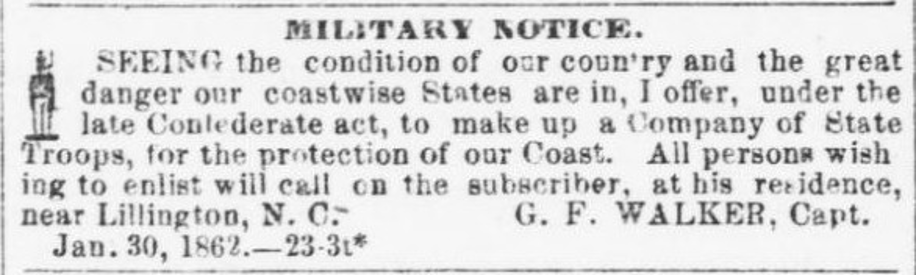
In January 1862, George Walker decided to raise an infantry company. He applied to the State for a captaincy and ran an ad in the Wilmington Journal seeking recruits. He was joined by his brother-in-law, John McAllister, who had received an appointment as a second lieutenant. [Click HERE to read more about John McAllister.]
By April 1862, Walker was ready to tender his company for State service. He presented his company muster to Captain John Cantwell, the enrollment officer at Camp Holmes. But Walker had a problem. His muster roll contained 42 names, not enough men to form a company, and only 33 of the 42 men were present. Cantwell was perturbed.
John Cantwell had been a colonel commanding the local militia. He had tried unsuccessfully to be elected to the colonelcy of the 8th and 10th Regiments of North Carolina Volunteers. Cantwell resigned from the militia and formed a company of railroad guards, but he still wanted to command a regiment. He intended to form an infantry regiment at Wilmington and got himself appointed enrolling officer for the new regiment. Walker was disrupting Cantwell’s plan.
Captain Cantwell talked to the soldiers in his company of railroad guards and convinced 27 of the men to transfer to Walker’s company. At the same time, Walker added six men from the 31st North Carolina to his muster. However, the six additions were never dropped from the Thirty-First’s rolls, and none of the men reported to Walker at Camp Holmes.
Finally, on April 17, 1862, Walker and his men were enrolled in State service as an infantry company. The company mustered into service six days later as Company A of the 51st Regiment North Carolina Troops. Although the company counted 74 men on its muster rolls, only 58 were actually serving in the company. Walker enlisted another seven soldiers before the end of May, but only five of them reported for duty.
George Walker’s brother, Washington, was one of May’s seven enlistees. Washington was serving as a private in Company C, 1st North Carolina and was home on leave. George signed him up as third lieutenant of Company A. The 1st North Carolina refused to release Washington, and he returned to his company. Washington Walker was killed at Sharpsburg in September 1862.
By July, Cantwell, now the colonel commanding the Fifty-First, had had enough. He arrested Captain Walker and charged him “with having made a false muster.” Walker was court-martialed in September. The results of the court-martial are unknown, but Walker continued to serve as commander of Company A, although Cantwell withheld his commission.
Cantwell resigned in October 1862, and Lieutenant-Colonel Allen, who succeeded Cantwell, resigned in January 1863. Major Hector McKethan was promoted to colonel; the lieutenant-colonel and major positions remained vacant until April. George Walker was the senior captain in the regiment, and as such, was next in line to be lieutenant colonel. But Colonel McKethan was vehemently opposed to Walker’s promotion.
Among McKethan’s complaints about Walker: “[H]e obtained a permit to go down town which expired yesterday at 10 A M and has since been absent without leave and is so reported this morning. I … feel that such conduct deserves punishment rather than promotion.” And “He is odious to most of the officers and men of the Reg and has the confidence of neither.”
Walker was passed over, and on April 9, 1863, Caleb Hobson (2nd senior captain) and James McDonald (3rd senior captain) were appointed as lieutenant-colonel and major. Walker submitted his resignation on May 14, 1863, and it was approved a week later. General Clingman insisted that Walker be immediately conscripted as a private into one of the regiment’s companies, but this did not happen.
Walker later obtained authorization to raise a company of 6-month volunteers, but no records exist of Captain Walker serving further in the military.
Walker returned to Mary and the farm in New Hanover County (later Pender County). By 1900, he and Mary had had eleven children, eight of whom were still living. George Fennel Walker died in Pender County on April 4, 1906.
Copyright © 2021 – 2026 by Kirk Ward. All rights reserved.