Jospeh Boykin Underwood was a very wealthy heir. In the 1860 census, Underwood listed his occupation as “gentleman.” His military career was unimpressive, but after the war he became an inventor, receiving at least 14 patents.
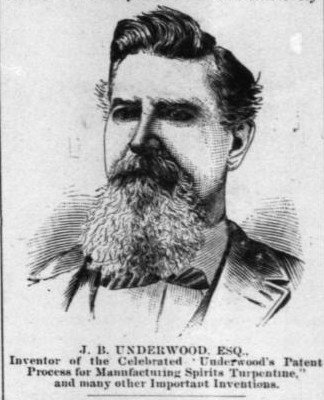
Joseph Boykin Underwood was born in Sampson County on March 6, 1838. His parents, John and Mary Boykin Underwood, were wealthy planters. They easily afforded sending Joseph to school in Fayetteville, where he received an excellent education.
Joseph’s mother died in 1858. Father John followed her two years later, in early 1860. Joseph and his brother David were appointed executors of John’s substantial estate. Among the items included in the final inventory of the estate were 125 hogs, 6,000 pounds of bacon, 200 barrels of corn, and $1,370 in cash. Joseph and David sold the homeplace and later sold a second plantation of 1,450 acres in Cumberland County. Each of the five Underwood children received today’s equivalent of $1 million dollars from the sale of John’s assets.
After Lincoln issued a call for troops on April 15, 1861, communities in North Caolina began raising companies in anticipation of the state’s inevitable secession. Joseph Underwood enlisted as a private in a company that William Devane was organizing in Sampson County. Devane’s company was initially assigned to the 20th North Carolina, but that regiment already had ten companies. As a result, Devane’s command remained independent until August 1862, when it was assigned to the 61st North Carolina.
Private Underwood enlisted on April 20, 1861. He was sent home on sick furlough the next day and did not return to his unit until September 20, 1861. He was present until March 3, 1862, when he received an appointment as a captain from the State. Underwood returned to Sampson County and began raising an infantry company that he called the Confederate Stars.
Underwood was not an energetic recruiter. In his first week as a captain, he only managed to enlist four soldiers. On March 17, newly-appointed First Lieutenant William F. Murphy transferred from Captain Caleb Hobson’s Warsaw Sampsons to Underwood’s company. Even with Murphy’s help, only 27 men had joined the Confederate Stars by the end of March.
By the end of April, Underwood and Murphy had enlisted 63 men, enough to muster a company. They took the Stars to Camp Holmes near Wilmington. On May 10, 1862, they were mustered into service as Company K of the 51st North Carolina. Eight more men enlisted in May, giving the Confederate Stars a complement of two officers and 71 men. All but six of the men hailed from Sampson County.
Oddly, the company did not have a second lieutenant until June, when Solomon Boykin (Joseph Underwood’s cousin) transferred to Company K from the 46th North Carolina. Second Lieutenant Edwin McKethan filled out the officer roster on July 12.
Joseph Underwood had a short, unremarkable career with the Fifty-First. He submitted his resignation in December 1862 to go home and tend to his father’s estate. His resignation was denied. He tried again in May 1863. Same result. He took a leave of absence in July 1863, but he returned to his company in time for the assault on Battery Wagner. Six weeks later, Underwood resigned for the third time. This time it worked. On September 7, 1863, Captain Joseph Underwood left the Confederate army for good. He was succeeded by Lieutenant William Murphy.
Back in Sampson County, Joseph Underwood continued to sell off his father’s land. On January 25, 1866, he married Sarah Haigh at St. John’s Church in Fayetteville. The couple set up house in Fayetteville, and Joseph opened a general merchandise store. They had two boys, William and John, in quick succession.
In February 1868, Joseph Underwood created a lamp for use on railroad cars. He demonstrated the device to the local newspaper and stated his intention to apply for a patent. This is the first formal record of any of his many inventions.
In the latter half of 1869, the family moved to Wilmington. They lived in a boarding house owned by Alice Lippitt, Sarah’s aunt. [Alice Lippitt was the sister-in-law of Captain James Lippitt, Company G, 51st North Carolina.] Joseph opened a store in Wilmington. The Underwoods’ third son, Joseph, jr., was born on July 9, 1870. Sadly, oldest son William died a week later.
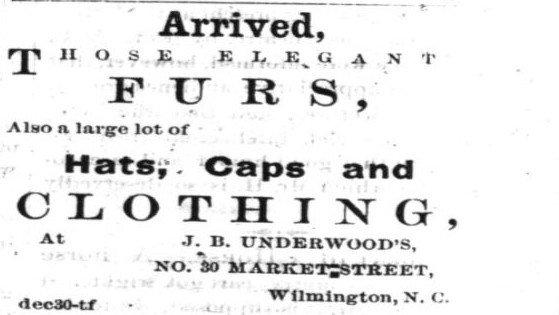
The Underwoods moved back to Fayetteville before March 1872, when their fourth son, George, was born. Joseph and Sarah added three daughters to the family before 1880. Joseph became a full-time inventor.
In 1874, Joseph received his first patent, filed the previous year for an improvement to cotton choppers and cultivators. The “Diamond Cotton Chopper” was lauded as a substantial improvement over current plows. It won honors at the 1874 State Fair. Joseph Underwood and two partners started the Diamond Cotton Chopper Company in 1875 to meet demand for the product.
“This plow must and will prove a great labor-saving implement in the cultivation of cotton, and we feel it a duty to compliment Mr. Underwood, as a benefactor to his country.” -State Agricultural Journal, quoted in the North Carolina Gazette, 18 Sep. 1873
In 1880, the Underwood clan, Joseph and Sarah, three boys, three girls, and Sarah’s mother, were living on Rowan Street in Fayetteville. Joseph opened a new store, selling steam engines, mills, turbines, and pumps. He also kept inventing, receiving 13 more patents over the next 20 years.
The family appears to have had a pleasant life in Fayetteville, but not without sorrow. Another daughter was born in 1881. Then son Devereaux was born in 1889, but he died eight months later. The Underwood’s final child, Hamilton, was born in January 1892, but daughter Mary died three months later, at the age of 16.
Sarah died on May 31, 1905. Joseph lived on for a couple of years. On January 6, 1907, Joseph Boykin Underwood was standing outside the LaFayette Hotel talking to a friend when he suddenly exclaimed, “Catch me,” and fell over dead.
“Really, it seems that his inventive capacity knew no bounds.” (Fayetteville Observer, 6 Oct. 1887)
Patents (from Google Patents and Google Apis)
- Improvement in cotton choppers and cultivators (1874) [This seems to have been Underwood’s most successful invention]
- Improvement in machines for harness makers (1879)
- Attachment for assisting in operation of sewing-machine treadle (1879)
- Improvement in darning attachments for sewing-machines (1879)
- Cigarette making machine [attached mouthpiece] (1892)
- Combination push button and fire alarm (1898)
- Tobacco stemming machine (1900)
- Tobacco stripping machine (1901)
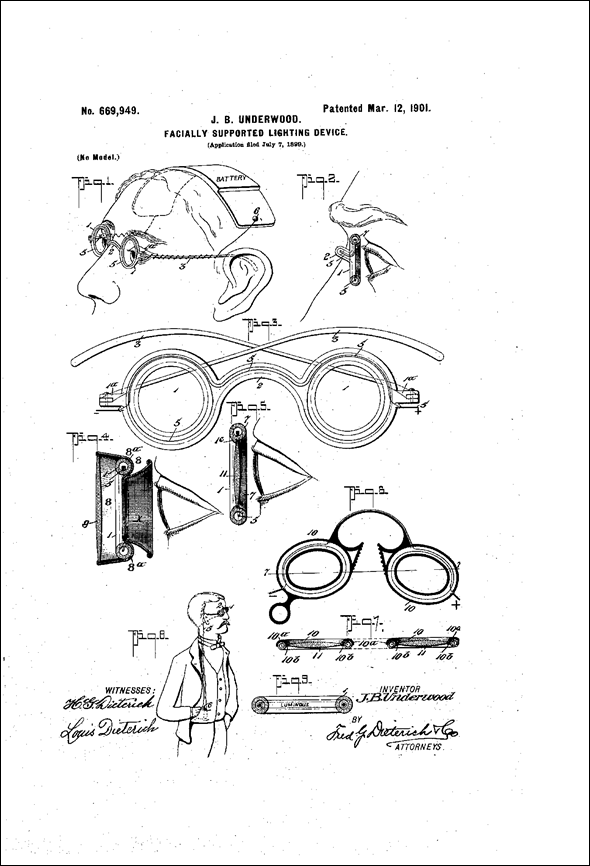
- Facially supported lighting device (1901)
- Refrigerator car (1902)
- Stop-motion device for spools (1903)
- Thread cutter and tier (1903)
- Process of harvesting and curing tobacco (1903)
- Thread cutter and tier (1905)
Other Inventions (no patent located)
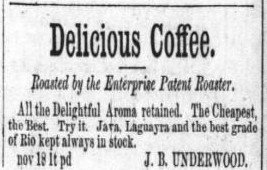
- Coffee roaster and grinder (1875)
- Chromatic (color) printing press (1887)
- Coin-operated cigarette vending machine (1887)
- Coin-operated ticket machine for street cars (1887)
- Turpentine still modification (1888)
- Cotton picker and harvester (1907)
- Burglar alarm (?)
Copyright © 2021 – 2026 by Kirk Ward. All rights reserved.