The genealogies I was able to locate while researching Willis Moore are suspect, so the information presented here is not as thorough as I’d like it to be. And I couldn’t find out what his middle initial stood for. Moore was just your average wealthy planter with a blind wife and who was once charged with murder.
Before the War
Willis P. Moore was born in Robeson County on June 29, 1830, to Alexander and Eliza Pope (Barnes) Moore. Willis’ father died in 1848, and his mother passed in 1860. Willis inherited the family plantation, making him very wealthy. In 1860, he and his wife, Mary E. Thompson, were farming in Robeson County and had three children at home. Moore’s land and personal property were valued at more than $1,000,000 in today’s dollars.
Military Service
In early 1862, Willis Moore decided to raise an infantry company, the Clay Valley Rangers. On February 28, 1862, he rounded up 73 local men and enlisted them in the army. The company then elected Moore as captain of the company and his 17-year-old cousin, Willis Pope, as 1st Lieutenant. [Pope was serving as a private in the 46th North Carolina at the time.]
At the end of March, Captain Moore assembled his company and took them to Camp Holmes near Wilmington. On April 10, the Clay Valley Rangers were mustered into service and were designated as Company E of the 51st North Carolina when the regiment organized two weeks later. Willis Moore, at 6′ 4″, was the tallest captain serving in the regiment.
By the end of May, 44 more men had joined the company. Of the 118 soldiers who initially joined Company E, all but seven were from Robeson County. The group included six Prevatt brothers.
Military life did not agree with Willis Moore. He had had asthma for a number of years, and his condition grew worse in the harsh environment of an army camp. He took sick leave in October 1862. Shortly after returning to camp, Moore submitted his resignation, citing his asthma as the main reason. But he also mentioned that his wife had become totally blind, and burglars had plundered his house while he was away. President Davis accepted Willis Moore’s resignation on December 9, 1862. Cousin Willis Pope was promoted to captain as Moore’s replacement.
After the War
Moore returned home and resumed farming. At the end of the war, he contracted a dozen or so sharecroppers from the freedmen who had formerly been slaves on his and neighboring plantations. On October 21, 1865, Moore shot one of the sharecroppers.
Willis P. Moore remained in Robeson County for his entire life. He farmed until age prevented him from doing so. Moore then moved in with his oldest daughter and her family. Willis died in her home on April 7, 1906. His obituary states that he was “one of the most prominent citizens of the county” and the “oldest mason in the county” at the time of his death.
The Death of Wesley Moore
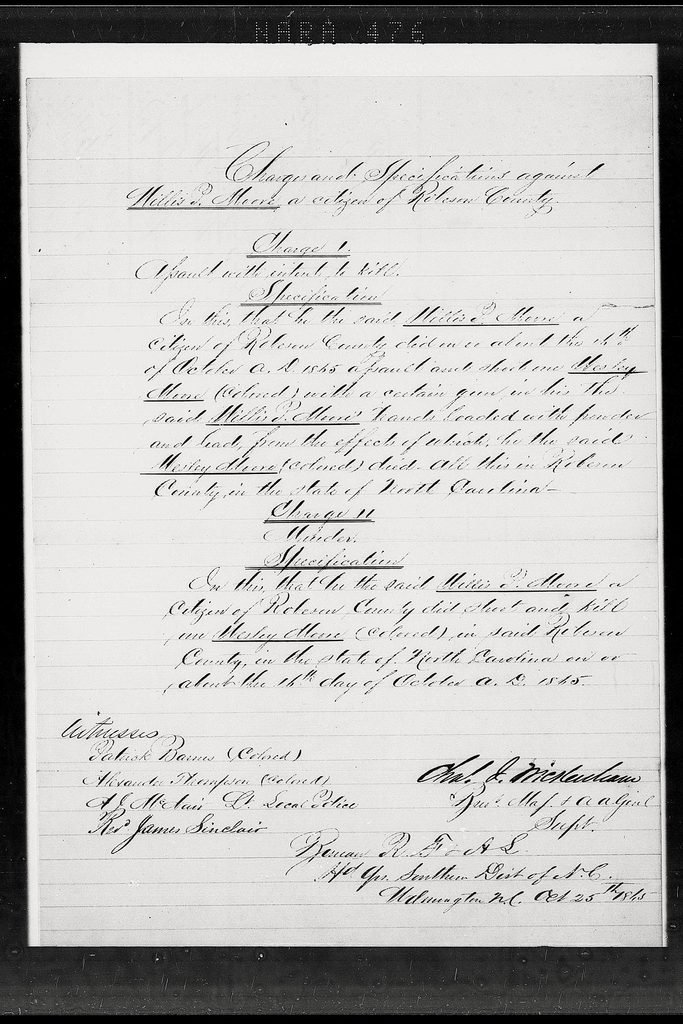
On October 21, 1865, Willis Moore and the sharecroppers shucked corn all day and into the night. After they finished, the men went home for a late supper. Around 11:00, they heard a shot. Two of the men, Alexander Thompson and Patrick Barnes, went to Moore and asked him about the gunshot. Moore replied that he had shot a man who was stealing corn, but it was too dark to see who the man was.
Thompson and Barnes walked to the barn and found another sharecropper, Wesley Moore (previously a slave on Willis P. Moore’s plantation), leaning against a basket of corn, moaning. It was apparent to the two men that Wesley had been trying to take the basket.
The two men walked back to Willis and asked him what he was going to do with Wesley. “I am going to let him lay there and die,” replied Moore. “… I have sent after Lieut. McNair of the Local police who could do with him as he pleases.” Lt. McNair arrived at Moore’s farm and consulted with Willis. “Willis P. Moore surrendered himself to me and said he gave himself and the negro up to me for me to do what I thought was best.” The two decided to send for Doctor Barnes, who tended to Wesley. Wesley died soon after.
The next day, McNair accompanied Willis Moore to Lumberton and delivered him to the captain of the local police. The captain referred the matter to James Sinclair, Commissioner of the Freedmen Bureau. Sinclair made the following statements about the incident: “W. P. Moore of Robeson Co. surrendered himself to me this day confessing that on the night of the 16th inst. he saw a man carrying away without his, Moore’s, consent a basketful of corn… .” And later, W. P. Moore is “a very worthy citizen and a loyal man. [T]he deceased was without doubt killed in the very act of stealing his employer’s corn.”
On October 25, the Headquarters for the Southern District of North Carolina charged Willis P. Moore with assault with intent to kill and with murder. No records exist that Moore was ever jailed or tried, or even arrested, for the killing.
NOTE: Reverend James Sinclair was a Presbyterian minister who had served as the colonel of the 35th North Carolina early in the war. He had been defeated for reelection as colonel and later requested an appointment as the colonel of the Fifty-First North Carolina. [See James Sinclair’s letter to Governor Vance.] Sinclair’s request was ignored, and he did not return to service. After the war, he served as chairman of the Robeson Freedmen’s Bureau and later served as a Republican legislator in Raleigh.
Copyright © 2021 – 2026 by Kirk Ward. All rights reserved.