James R. McDonald [I was unable to find out what the “R” stood for] was born on June 18, 1826, in Cumberland County. His father made a comfortable living as a saddler in Fayetteville, allowing James to attend school and get a solid education.
In 1849, James McDonald’s younger sister, Elizabeth, married Fayetteville merchant Poindexter Shemwell. James moved to Salisbury and went to work for Poindexter’s brother, William, also a merchant. McDonald remained in Salisbury two years, working as a store clerk at Ennis, Shemwell and Company.
William Shemwell bought out his partners in February 1852. James McDonald moved back to Fayetteville and bought a partnership interest in Poindexter’s store (Arey, Shemwell and Company). That summer, McDonald travelled to Columbus, Georgia and married Mary J. McNeill, formerly of Robeson County. Mary accompanied her husband back to Fayetteville.
A handsome fellow, standing 6’ 1” tall with light hair and blue eyes, McDonald was known to be kind-hearted, considerate, and courteous. He was involved in civic affairs, and he enlisted as a private in one of Fayetteville’s militia companies, the LaFayette Light Infantry. James and Mary settled into their new home and began a family.
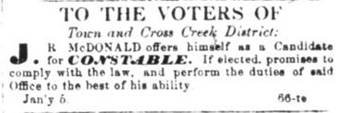
Arey, Shemwell, and McDonald dissolved their partnership near the end of 1852, and McDonald opened a new store with John McMaster. That store seems to have gone under sometime in 1855. In 1856, McDonald ran for town constable, an election that generated “almost as much excitement as a Presidential election.” McDonald won.
In the 1860 census, James McDonald and wife Mary are living in Fayetteville with four children. McDonald gives his occupation as a clerk. When he mustered into service two years later, he stated that he was a merchant.
As North Carolina moved toward secession, the men of the Lafayette Light Infantry, including Private James R. McDonald, offered their services to the State. The unit was assigned as Company F of the 1st North Carolina Volunteers. The regiment was sent to Virginia where it fought at Big Bethel. The First NCV had only enlisted for six months, and in November the regiment returned home and disbanded.
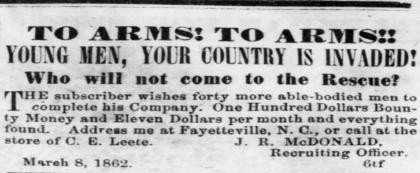
On February 22, 1862, James R. McDonald received an appointment from the State as a captain. Robert McEachern of Robeson County received an appointment as a first lieutenant on the same day. The two men, who had served together in the 1st NCV, began enlisting soldiers for a new infantry company that they called the “Scotch Tigers.”
By the end of March, Captain McDonald and Lieutenant McEachern had signed up 75 men, 50 of whom resided in Robeson County. McDonald ordered his recruits to assemble on April 7th with “blankets and one suit of clothes extra.” Once assembled, the company marched to Raleigh. The Scotch Tigers arrived at Camp Mangum three days later. On April 14, 1862, the Tigers were enrolled in service by Major James Iredell [later major of the 53rd North Carolina].
A few days after the Scotch Tigers were enrolled, the military department ordered McDonald to take his company to Wilmington where it would become part of the 51st North Carolina. Captain McDonald loaded his men on a train and took them to Wilmington. When the Fifty-First organized on April 23, the Scotch Tigers became Company D of the new regiment. Meanwhile, the Tigers continued recruiting. On May 7, thirty-seven more Robeson County men took the cars to Wilmington and joined Company D at Camp Holmes.
In late-May, McDonald’s company was sent below Wilmington to build an ironclad battery (later known as Fort French) on the Cape Fear River. Company D rejoined the regiment in early September, near Kinston. For the next three months, the Tigers performed picket duty between Kinston and New Bern, watching for Yankee incursions. During this time, Captain McDonald was absent sick for two weeks, his only sick leave during his military career.
In December, the 51st North Carolina was rushed to Goldsboro to stop a Union expedition sent to destroy the railroad bridge near that town. Captain McDonald led his company in battle for the first time.
The Fifty-First’s colonel, John Canwell, resigned suddenly in October and returned home. Lieutenant Colonel William Allen assumed command of the regiment. However, Allen’s tenure was short. He was forced to resign in January 1863 after a drunken confrontation with the regiment’s major, Hector McKethan. McKethan was promoted to colonel, but the lieutenant colonel and major positions were left unfilled while the powers that were argued about which captains should be promoted to field command. [Click HERE for more information about the debacle with field command.]
The officers of the regiment held a vote among themselves and petitioned General Clingman to promote Captains George Sloan (Co. I) and William Norment (Co. F) as the regiment’s lieutenant colonel and major. McDonald was hurt. Not a single officer voted for him to be promoted. On January 12, 1863, Captain McDonald submitted his resignation. It was declined.
Finally, in April, the issue with the regiment’s field officers was resolved. Captain James McDonald received an appointment to major from Governor Vance. McDonald was satisfied. He immediately took a leave of absence to procure a horse.
For the next year, Major McDonald performed well. He was commended for his leadership during the Yankee assault on Battery Wagner in Charleston. He was with the regiment during its fierce engagement at Drewry’s Bluff in May 1864. But in June 1864, McDonald’s service with the regiment came to an end.
On June 1, 1864, the 51st North Carolina was nearly surrounded at Cold Harbor. Enemy troops had attacked the regiment in flank and rear. During the resulting chaos, a Yankee officer rushed Major McDonald, pointed his pistol at the major’s head, and demanded he surrender or die. McDonald surrendered.
Major McDonald and the men captured with him were imprisoned at Point Lookout, Maryland. Ten days later, McDonald was transferred to the officers’ prison at Fort Delaware. On August 20, he was selected as a group of 600 prisoners, later called “The Immortal 600,” to be transferred to Morris Island and act as a human shield for the Union garrison at Battery Wagner.
After six weeks on Morris Island, the captives were transferred to Fort Pulaski, near Savannah. The unfortunate prisoners were subjected to freezing temperatures with little clothing and few blankets. They were placed on starvation rations consisting of moldy cornmeal and sour onion pickles. The men were ravaged by dysentery and scurvy. Twenty-one prisoners died.
In March 1865, with the war winding down, the prisoners were transferred back to Fort Delaware. On the return journey, Major McDonald was left at the Hilton Head hospital, where he was treated for acute dysentery. After three weeks in the hospital, McDonald was forwarded on to Fort Delaware, where he was paroled on July 24, 1865.
After the war James McDonald moved with Mary and their five children to Atlanta where he worked as an auctioneer. Sometime before 1880, McDonald moved to Memphis. He was still employed as an auctioneer. By 1900, James McDonald was a retired widower living with his youngest daughter, Clara Rupple. In 1903, he moved to Fayetteville and lived with his other daughter, Mary Watson. James R. McDonald died at his daughter’s house on June 10, 1905. He is buried in Elmwood Cemetery, either in Fayetteville or Memphis. His Find-A-Grave memorial lists Elmwood Cemetery in Fayetteville, but the memorial does not include a photo of his tombstone. His obituary states that the body was to be transported to Memphis and interred in the Elmwood Cemetery there.
Copyright © 2021 – 2026 by Kirk Ward. All rights reserved.